The Inside Story: Why a Borescope Inspection is Your Engine’s Best Insurance Policy
In the world of general aviation, there is an old saying: “If you think professional maintenance is expensive, try neglecting it.” For aircraft owners, the engine is not just a mechanical heart; it is a significant financial investment and the primary guarantor of safety.
Traditionally, understanding the health of an engine’s internal components, cylinders, valves, and piston crowns, required a “top overhaul,” a labour-intensive process that involves removing cylinders and can cost thousands of dollars. However, modern technology has provided a more efficient, non-invasive alternative that has revolutionized engine management: the digital borescope.
At Brant Aero, with over 40 years of experience as a Transport Canada approved AMO (#10-74), we have seen how a simple borescope inspection can save an engine, and a budget. Here is why this tool is indispensable for every aircraft owner.
What is a Borescope Inspection?
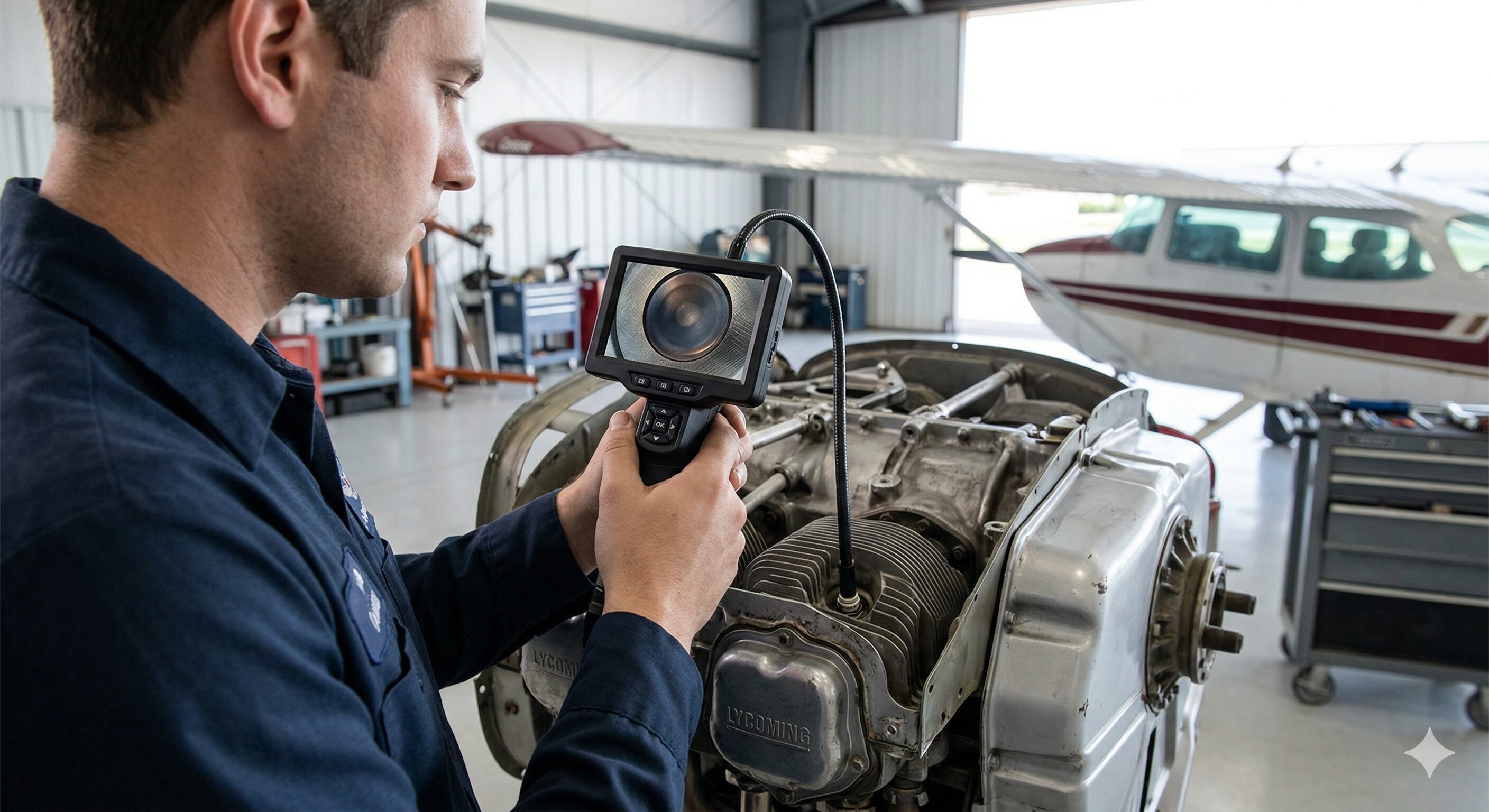
A borescope is a specialized optical device, essentially a tiny, high-resolution camera on a flexible or rigid probe, designed to enter tight spaces. In a piston engine, this camera is inserted through the spark plug hole, allowing a technician to view the entire combustion chamber without turning a single bolt on the cylinder itself.
For decades, borescopes were grainy and difficult to interpret. Today, we use high-definition digital borescopes that allow us to capture crystal-clear images and video. This “inside story” provides a level of detail that a standard compression test simply cannot match.
Why Do It? Moving Beyond the Compression Test
For years, the Differential Compression Test was the gold standard for engine health. While still a required part of every annual inspection, the compression test has a major flaw: it only tells you if a cylinder is leaking air, not why or where.
A cylinder might show a “passing” grade of 74/80, yet be harbouring a burnt exhaust valve that is hours away from failure. Conversely, a cylinder might show a “failing” grade of 58/80 due to a bit of carbon on the valve seat that would clear up after a short flight.
The borescope bridges this gap. It allows us to:
- Identify Burnt Valves: We can see the “pizza” or “cloverleaf” heat patterns on an exhaust valve before it fails.
- Check Cylinder Walls: We look for the presence of original cross-hatching or, more importantly, signs of vertical scoring and corrosion.
- Inspect Piston Crowns: We can identify lead deposits, detonation damage, or signs of oil “gulping.”
- Detect Corrosion: As we discussed with engine additives like AvLube, corrosion is a silent killer. A borescope can spot the microscopic pitting on cylinder walls that indicates an engine has sat idle for too long.
When Should You Perform a Borescope?
At Brant Aero, we recommend a “proactive” rather than “reactive” approach to engine inspections.
1. At Every 50-Hour or 100-Hour Oil Change
Waiting for your “Annual” to look inside the engine is a gamble. By borescoping at every oil change, you establish a visual baseline. Tracking the color and wear patterns of an exhaust valve over 200 hours is the most effective way to predict a failure before it happens in the air.
2. During a Pre-Buy Inspection
Never, under any circumstances, buy a used aircraft without a thorough borescope of all cylinders. A logbook may say the engine is “mid-time,” but a borescope might reveal “resting corrosion” that could necessitate a $40,000 engine overhaul six months after you take delivery.
3. When Your Engine Monitor Flags an Issue
If you have a digital engine monitor (like a JPI or Garmin) and notice a sudden rise in Exhaust Gas Temperature (EGT) or a “rough” running engine, a borescope is the first tool we reach for. It allows us to quickly rule out, or confirm, catastrophic internal damage.
The Savvy Aviation Influence: A Shift in Philosophy
The push for more frequent borescope inspections has been championed by industry leaders like Mike Busch and Savvy Aviation. Their philosophy, which we largely share at Brant Aero, revolves around Reliability Centered Maintenance (RCM).
The goal is to stop “fixing things that aren’t broken” and instead use data and visual evidence to determine when a component actually needs service. Savvy Aviation has analyzed thousands of engine failures and concluded that the exhaust valve is the “weak link” in the modern piston engine. By using high-quality borescope images, owners can often extend the life of their cylinders well past the manufacturer’s TBO (Time Between Overhaul) by catching and addressing small issues like “stuck valves” or “heavy carbon” before they lead to metal-to-metal failure.
The Benefits: Safety, Longevity, and Cost Savings
1. Unmatched Safety
The most critical benefit is the prevention of in-flight engine failures. An exhaust valve that fails usually results in a complete loss of power in that cylinder. By identifying a “failing” heat pattern on a valve during a routine inspection, we can replace a single cylinder on the ground rather than dealing with an emergency landing.
2. Massive Cost Savings
A borescope inspection is relatively inexpensive, usually taking about an hour for a 6-cylinder engine. Compare that to the cost of a “top overhaul” or a premature engine replacement. If a borescope reveals a valve that isn’t rotating properly, we can often perform a “rope trick” or ream the valve guide to fix the issue for a few hundred dollars, potentially saving a $3,000 cylinder replacement.
3. Peace of Mind
There is a psychological benefit to seeing the “insides” of your engine. Knowing that your piston crowns are clean and your valves are healthy provides a level of confidence that no logbook entry can replicate.
Best Practices: What We Look For
When our technicians at Brantford (CYFD) perform a borescope, we aren’t just looking for “shiny bits.” We follow a disciplined checklist:
- Valve Symmetry: A healthy exhaust valve should have a symmetrical, circular heat pattern. If the pattern is lopsided (resembling a crescent moon), it means the valve is not seating properly and is localized “hot spots” are developing.
- The “Green” Sign: On some engines, a valve that is starting to fail will turn a distinct greenish-white color. This is a “land now” sign for maintenance professionals.
- Cross-Hatching: We look for the distinct diagonal lines on the cylinder walls. If these are gone and the walls are “mirror-smooth” or “glazed,” the engine may begin to consume excessive oil.
Conclusion: Don’t Fly Blind
In an era where avionics are becoming more advanced, it is easy to forget that the mechanical health of the engine is what keeps those screens powered. A borescope inspection is the most cost-effective, high-impact maintenance task an owner can request.
At Brant Aero, we combine our 50+ years of heritage with these modern diagnostic tools to keep the Canadian aviation community flying safely. Whether you are coming in for a routine oil change or a complex annual, ask our team to “take a look inside.” It’s the only way to truly know the heart of your aircraft.
Keep Your Engine Healthy
Ready for your next inspection? Trust the experts who have been serving the GA community for four decades.